
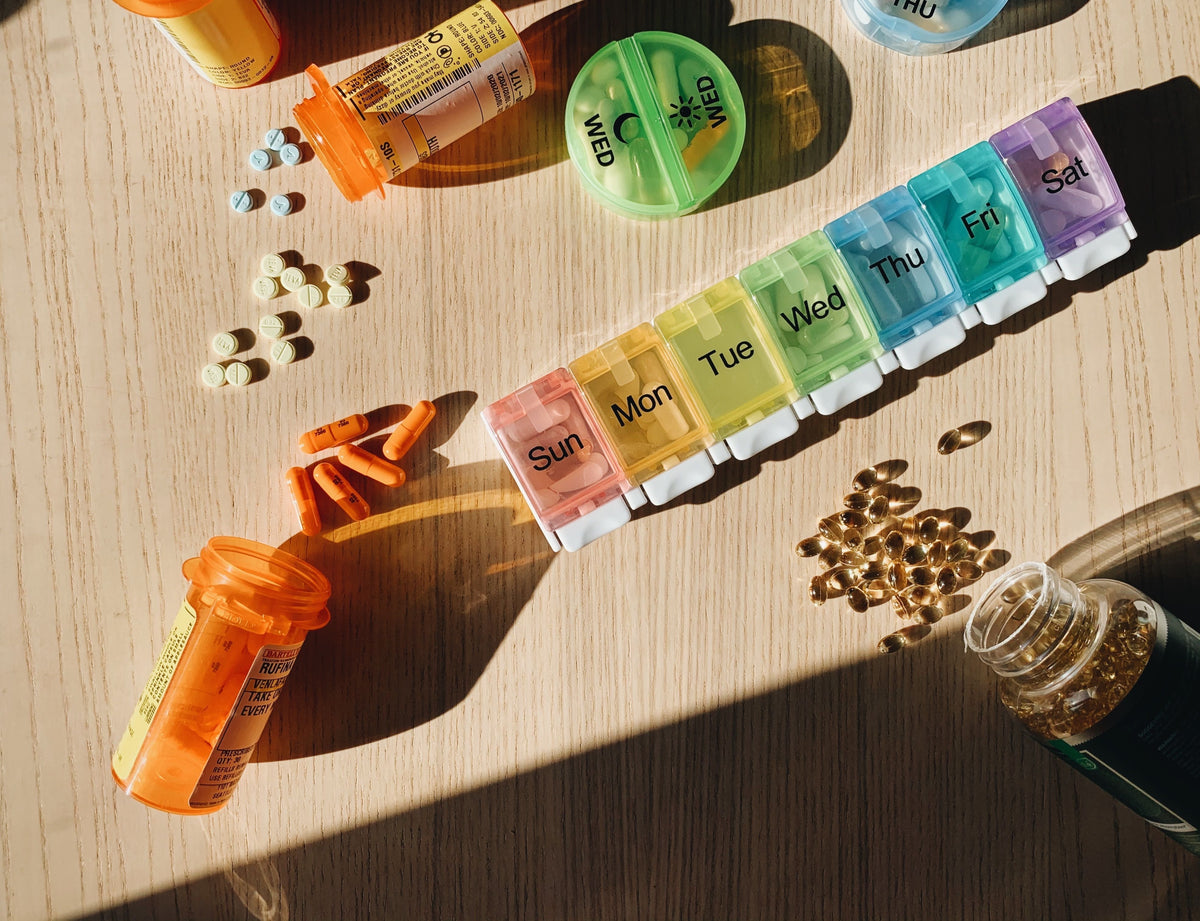
Short answer
- No. Nitroglycerin should stay in the original glass bottle, tightly capped.
- The FDA-approved label says this specifically, and it's stricter than the guidance for most medications.
- The reason is that nitroglycerin is volatile and adsorbs onto plastic and cotton, so a plastic organizer actively pulls the drug out of the tablet.
- Weekly organizers are fine for most of your other medications. Nitro is the exception.
- If the problem you're solving is carrying the bottle, solve that instead of decanting the tablets.
This comes up constantly, and it comes from a reasonable place. If you take six medications a day, a weekly organizer is the difference between managing your health and losing track of it. So when a cardiologist adds nitroglycerin to the list, the natural instinct is to put it in the Sunday compartment with everything else.
Nitroglycerin is genuinely different, though, and this is one of the few times a warning about original containers is about chemistry rather than about labeling.
What the label actually says
The FDA-approved label for Nitrostat, and the patient information Pfizer publishes, both carry the same sentence:
“NITROSTAT should be kept in the original glass container and tightly capped after each use to prevent loss of tablet potency.”
Two specific instructions are doing work there. Original glass container, and tightly capped after each use. Neither is a formality.
Why nitroglycerin is the exception
Nitroglycerin is volatile, which in this context means it doesn't stay put. Over time it moves out of the tablet as vapor. In a sealed glass bottle that vapor has nowhere to go, the air inside saturates, and the process largely stalls out. That's what the glass and the tight cap are for.
It also adsorbs onto certain materials, particularly plastics and cotton. This is well documented and it's the reason pharmacists tell you to discard the cotton wad that comes packed in the bottle. The cotton isn't inert, it's a sponge for the active ingredient.
A weekly pill organizer is plastic, it's opened daily, and each compartment holds a large volume of air relative to one small tablet. Every one of those features works against you here.
The bottle compared with an organizer
| Original glass bottle, capped | Loose tablets in a plastic organizer | |
|---|---|---|
| The container | Glass, capped after each use | Plastic, opened daily |
| Vapor | The air inside saturates and the process largely stalls out | A large volume of air sits around one small tablet |
| Material contact | Glass gives the drug nothing to stick to | Plastic is a material nitroglycerin adsorbs onto |
| The label | What the label asks for | Not what the label asks for |
| Potency over time | Holds longer | Lost faster than tablets left in the bottle |
The practical consequence is that tablets in an organizer lose potency faster than tablets in the bottle. How much faster depends on the plastic, the temperature, and how often the lid comes up, and I haven't seen a study that puts a clean number on it. What I can tell you is that the direction is not in question and the manufacturer's instruction is unambiguous.
The contradiction nobody addresses
Here's the part that frustrates me about most of the advice on this.
Health authorities say keep medication in the original container. Millions of people use weekly organizers, because without one they'd miss doses, and missing doses is a real and serious harm. Both of those things are true and nobody writes about the collision between them.
The resolution is that the “original container” rule matters much more for some medications than others. For a stable tablet in a dry compartment for seven days, an organizer is a reasonable trade, and the adherence benefit is worth far more than the marginal risk. For nitroglycerin specifically, the chemistry pushes the other way, and there's an additional reason. Nitro is a rescue medication. You don't take it on a schedule, so it gets none of the adherence benefit an organizer exists to provide. You're accepting the downside and getting nothing back.
So use your organizer. Just leave the nitro out of it.
What to do instead
The real problem behind the question is almost always portability. The bottle is bulky, it rattles, it doesn't sit well in a pocket, and it's easy to leave behind. Decanting a few tablets into something smaller solves that, at a cost.
There's another way to solve it, which is to carry the bottle itself in something that makes it easy to carry. That's what our Wide Single Chamber holder is, essentially. A standard 25-count Nitrostat or LifeStar bottle drops in with the cap on and it goes on a keyring, sealed inside stainless steel. The Large Dual Chamber does the same and adds a second chamber, which most people use for aspirin.
You keep the glass, you keep the cap, you keep the pharmacy label attached, and the bottle stops being a thing you have to remember.
One caveat about my own product line. We also sell an extra-small holder that takes about seven loose tablets, and some customers use it as a backup supply. It is not what the label asks for, and tablets kept that way will need replacing more often. If you go that route, tell your pharmacist so they can advise you on timing.
Questions people ask
What about a metal pill box instead of plastic?
Better than plastic on the adsorption question, but it still doesn't meet the instruction, which asks for the original glass container specifically. The bottle is the answer, and the container problem is best solved around the bottle rather than instead of it.
Can I put nitro in the same compartment as my aspirin?
Keep them separate. Mixing medications in one chamber makes it harder to grab the right one under pressure, and nitroglycerin vapor can migrate to whatever it's sitting against. That's the reason our dual chamber holder has two sealed compartments rather than one.
My pharmacy gave me a plastic bottle, not glass.
Some generics do come in plastic. Follow the instruction on the container you were given, keep it tightly capped, and ask your pharmacist whether they can dispense in glass if you'd prefer it.
Are weekly organizers bad for everything else?
No. For most maintenance medications the adherence benefit outweighs the storage tradeoff. This is a nitroglycerin-specific answer.
Educational information, not medical advice. Ask your pharmacist about your specific product.
Sources
Nitrostat FDA label ·
Pfizer patient information ·
DailyMed ·
Instability of nitroglycerin tablets, 1974