
Short answer
- Heat and humidity both degrade sublingual nitroglycerin.
- Package size matters more than most people expect. In a 2018 study, a 100-count bottle carried in a pants pocket fell below acceptable potency at twelve months, while a 25-count bottle in the same pocket was still good at two years. Bottles kept in a purse held potency past two years either way.
- Nitroglycerin is volatile. It leaves the tablet as vapor over time and sticks to plastic and cotton, which is why the label asks you to keep it in the original glass bottle, capped.
- Store at 20 to 25°C, or 68 to 77°F. A parked car in summer routinely passes 50°C.
- You cannot tell by looking whether a tablet has lost potency, which is the reason storage matters more than inspection.
Heat does degrade nitroglycerin. That part is settled, and most people who ask about it already suspect the answer.
What's less obvious is that the scenario people worry about, a bottle left in a hot car, is rarely the one doing the damage. The bigger exposure is quieter and happens every day.
What heat does to nitroglycerin
Nitroglycerin is a volatile compound. In tablet form it doesn't sit still the way most medications do. It gradually sublimes, moving from the tablet into the surrounding air, and it has an affinity for plastic and cotton, which is why pharmacists tell you to throw away the cotton ball that comes stuffed in the bottle. That cotton will pull nitroglycerin out of your tablets.
Heat speeds all of this up. So does humidity. The two together are worse than either alone, and the combination is why a bathroom cabinet is close to the worst place in a house to keep this particular medication.
The manufacturer's storage instruction is 20 to 25°C, which is 68 to 77°F, with brief excursions permitted between 15 and 30°C. That's the USP definition of controlled room temperature and it appears on most prescription labels. What makes nitroglycerin different is the second instruction, which shows up in the FDA-approved label for Nitrostat:
“NITROSTAT should be kept in the original glass container and tightly capped after each use to prevent loss of tablet potency.”
Most medications don't get that sentence. Nitroglycerin does because the glass and the tight cap are doing real work, holding the vapor in.
The labelled storage range, and everyday temperatures
See the numbers
| Where | Temperature | Against the range |
|---|---|---|
| Parked car in summer sun | 120°F and above | Far above |
| Body temperature | 98.6°F | Above |
| Storage range on the label | 68 to 77°F | In range |
| Refrigerator | About 40°F | Below |
The finding that surprised me
In 2018 a research team published a study in the American Journal of Cardiology that did something unusual. Rather than testing tablets in a laboratory oven, they tested them the way people actually live with them.
Here's what they found.
How long nitro lasts, by bottle size
See the numbers
| Carrying condition | How long potency held |
|---|---|
| Purse, any bottle size | 2 or more years |
| Pants pocket, 25-count bottle | 2 years |
| Pants pocket, 100-count bottle | 12 months |
The package size result is the one worth sitting with. Same drug, same pocket, and the outcome turned on how much empty air was inside the bottle. Nitroglycerin sublimes into whatever headspace is available, so a large bottle with a few tablets rattling around loses more than a small bottle that's nearly full. The authors put the variation down to temperature, headspace and carrying practices, and concluded that refill frequency should be based on individual behavior rather than a fixed schedule.
A glove box in August is a more dramatic exposure. A large bottle with plenty of air in it is a quieter one that never stops.
What this means practically
Keep the tablets in the glass bottle they came in, and put the cap back on tight every single time. This is the highest-value thing on the list and it costs nothing.
Think about how full the bottle is. A nearly empty large bottle has more air inside it, and that air is where the drug goes. If you've been carrying the same 100-count bottle for months, ask your pharmacist about a smaller fill.
Keep it out of the bathroom. Showers produce exactly the heat-plus-humidity combination that does the most damage. A bedroom drawer is better and free.
Don't leave it in a car. Interior temperatures in a parked car in direct summer sun regularly pass 50°C and can go higher, which is well outside anything the medication is rated for.
And throw out the cotton once you open the bottle, but keep any desiccant packet if one came with it.
Can you tell if it's gone bad?
Not reliably. There's an old piece of folklore that potent nitroglycerin produces a tingling or burning under the tongue, and that no tingle means no potency. It isn't dependable. Plenty of people get a good response with no tingling, and the sensation can come from the inactive ingredients.
This is really the whole argument for taking storage seriously. With a medication you take daily, you'd notice a problem. With a rescue medication you might use twice a year, the first time you find out it's degraded is a time you very much need it to work.
If you have any doubt about a bottle, ask your pharmacist rather than testing it.
Where our holders come into this
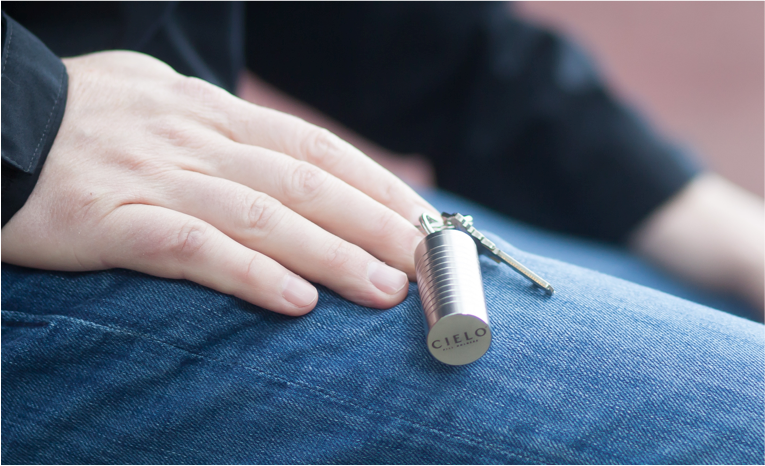
Our Wide Single Chamber and Large Dual Chamber holders take the original glass bottle, cap on, and seal it inside stainless steel on a keyring. You aren't decanting into anything larger, the cap stays tight, sweat and rain stay out, and the pharmacy label stays attached for anyone who needs to read it in an emergency.
It isn't a cooler and I won't claim it is. What it does is keep the bottle sealed, capped and with you.
Questions people ask
Is one hot afternoon enough to ruin it?
Probably not. The degradation described in the research happened over months of sustained exposure. A single hot day is unlikely to destroy a bottle, though repeated hot days will add up. If a bottle has spent a summer in a car, replace it and don't agonize over it.
Does the freezer or fridge help?
No, and cold introduces a condensation problem. There's more in our piece on refrigerating nitroglycerin.
What about a plastic pill organizer?
Not for nitroglycerin. Plastic is one of the materials it adsorbs onto. Longer answer here.
Should I be replacing it every six months?
That was the standard advice for a long time and it came from older data. Here's what the current evidence says, though your pharmacist should have the final word.
Educational information, not medical advice. Follow your doctor and pharmacist on how to store and replace your nitroglycerin.
Sources
Nitrostat FDA label ·
Nawarskas et al., Am J Cardiol 2018 ·
Instability of nitroglycerin tablets, 1974 ·
Drugs.com